About
Chapman Point is a Marine Garden
Marine Gardens are designated to protect rocky habitat resources through public enjoyment, learning opportunities, and by maintaining ecological integrity. No change to fish harvest beyond baseline ODFW regulations. No take of invertebrate or marine plant harvest in the intertidal except for single mussels for recreational bait and scientific research permits*.
Features
Key Resources
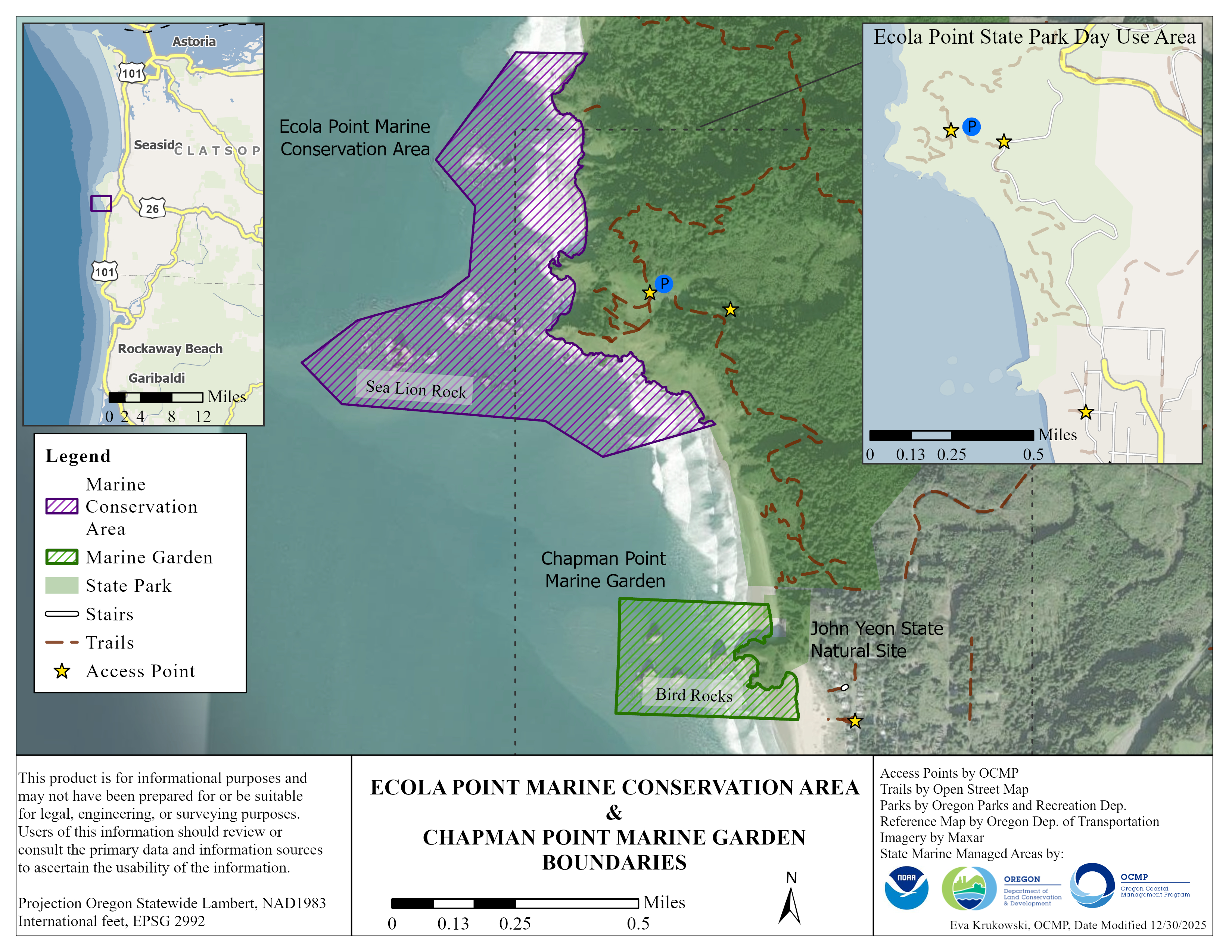
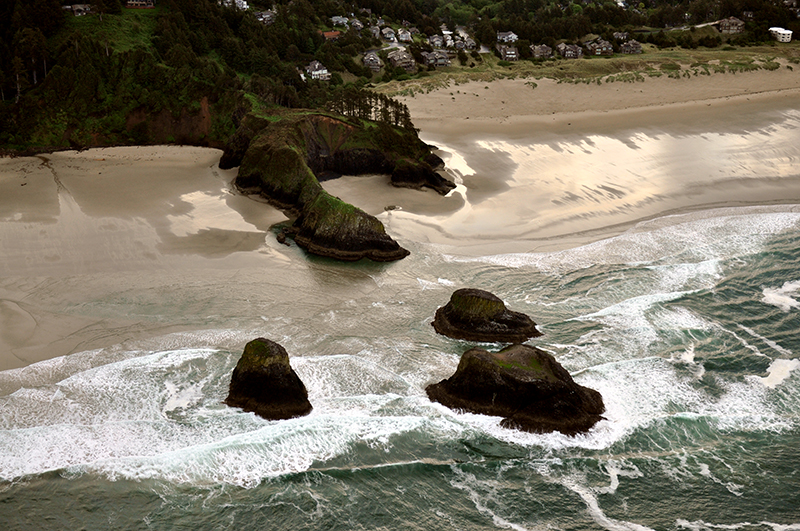
The Chapman Point Marine Garden Boundary includes all state-owned submerged and submersible land encompassing the shoreline around Chapman Point, extending 194 yards north and 211 yards south of the tip of Chapman Point (perpendicular to West 7th St. beach access), and extending out seaward to 405 yards from the tip of Chapman Point. The four largest sea stacks within the boundaries are called Bird Rocks.
Chapman Point has impressive breeding colonies of seabirds - including 34 of high importance according to the SeaSketch report. This includes colonies of 10,000+ Common Murres and several nesting areas for the Black Oystercatcher, federally listed as a “species of concern” due to its decreasing populations. The tide pools are home to diverse wildlife including Ochre Sea Stars, Giant Green Anemones, California Mussels, Red Rock Crabs, and countless other animals, from chitons to octopus.
Site Uses
Located at the northern edge of the City of Cannon Beach, the rocky habitat at Chapman Point boasts breathtaking views, magnificent rock formations, and tide pools full of life. Chapman Point is loved by residents, serving as a stunning place for community members and visitors to walk, watch sunsets, take their children and grandchildren, and view wildlife. Visitors commonly use Chapman Point for walking, running, dog walking, tidepool exploration, photography, bird watching, fishing, and kayaking.
Access
It is located just 1.7 miles north of Haystack Rock, one of the most iconic locations on the Oregon Coast and home to a breeding colony of Tufted Puffins. This stretch of rocky habitat includes some of the most visited on the coast, putting it at high risk of habitat
degradation.
Chapman Point site is most commonly accessed from several access points at Chapman Beach at the north end of the City of Cannon Beach, including at the western ends of West 7th Street and West 5th Street. It is also accessed from the central beach of Cannon Beach (the “main” beach, which sees the highest visitation), by crossing Ecola Creek, which separates the two beaches. It is also accessed from Crescent Beach to the north, at low tides by crossing the sand bridge between Chapman Point and the first Bird Rock, or around the western (ocean-facing) side of the first Bird Rock when tides are low enough.
Management
Site Management
The Chapman Point Marine Garden goals are to preserve and strengthen the ecological integrity of the site including existing marine life, fish, seabird and shorebird nesting areas that exist in these rocky habitats for long term sustainability, and to provide an
opportunity for public outreach and education to help achieve the first goal and to educate members of the public that are walking north toward Ecola Point.
The Chapman Point Marine Garden Management Plan (Plan) provides a framework for implementing site-based management actions at the Chapman Point Marine Garden. Management focuses on education, stewardship, and community science to protect the high biodiversity at this site.
View the Chapman Point Marine Garden Management Plan, February 2026
Regulations
No take of shellfish and other invertebrates in the intertidal with the exception of single mussels (for bait).
Ownership
- Submerged and intertidal lands: Department of State Lands;
- Offshore rocks above Mean High Water (MHW): U.S. Fish and Wildlife Service;
- Dry sands beach is a state recreation area under the jurisdiction of Oregon Parks and Recreation Department;
- Upland beyond the statutory line of vegetation is owned and managed by Oregon Parks and Recreation Department as the John Yoen State Natural Site.
Map